

When one thinks about the nature of chivalry, it tends to be conflated with basic gentlemanliness such as holding a door open or walking on the street-side of the side walk. This is inadequate and incorrect. Chivalry, rightly understood, primarily tied to honorable conduct in warfare and the cultivation of virtue in all areas of life. The knight swore fealty to his lord, whether monarch or lesser noble, and acted as a representative of his lord’s authority both in the maintenance and defense of the realm.
The manorial system, the form of feudalism seen throughout most of Western Europe in the Middle Ages, was a system of relationships between individuals. In each relationship there was a superior and an inferior. The inferior swore fealty to the superior and was rewarded with land, privileges depending on rank, and protection. In return, the superior had the right to tax the goods and produce of the inferior and to call upon them in times of war.
This system was the same at every level, whether a serf to a minor landed noble or a noble to a king. The only notable differences were the privileges gained and the duties expected. The higher your rank, the more you were expected to provide and do. The superior always provides more benefit to the inferior than he receives. This is the standard agreement in feudal societies as well as between nations when one is suzerain over another.
Here, we see the cornerstone of chivalric masculinity. The oath. It’s still commonly stated today that a man’s word is his bond. The oath seals the relationship, outlining the duties and privileges of one’s station. A knight is a man who swears an oath unto death. If the oath is broken, death. And if the oath is fulfilled, also death, at least in some circumstances. The ideal of the knight is a man who upholds his oath, who defends the weak and innocent, and who embodies the virtues of strength, gentleness, mercy, and courage.
To be a knight is to understand that you are not at the top. You yourself have sworn fealty to a lord, and you have a higher duty to God. An oath is made to another person by invoking a higher power, God, and swearing to uphold the will of the superior and the customs of the land so long as they are within the bounds of the higher, divine law.
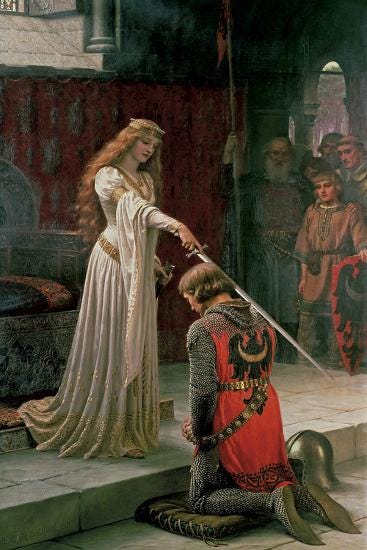
A common phrase found in oaths is promising to “love all that he [the lord] loves and to shun all that he shuns.” It is to align yourself fully with them in a manner more intimate even than with your family. The knight calls a curse upon himself should he ever forsake his duty. This is not blind obedience, however, and the knight’s duty extends beyond simply protecting his lord and realm.
The knight fights dragons and rescues princesses. It is in the Matter of Britain, or Arthurian Legend, we see the ideal of the knight most readily. Let us look at an exchange from Roger Lancelyn Green’s King Arthur and His Knights of the Round Table from 1953:
“Well,” said Sir Tor, “ask a gift, fair damsel, and will give it you.”
“I thank you,” she answered. “And now I shall ask you for the head of this false knight Abelleus, for he is the most outrageous knight living, and the wickedest murderer.”
“Now I repent me of my promise,” said Sir Tor. “Cannot he make amends for any wrong that he has done you?”
“Not possibly,” said the damsel, “for he slew my own brother before mine eyes, and would not spare him, though I knelt half an hour in the mud begging him for mercy. So strike off his head quickly, I beg of you – or else I shall shame you as a false knight at the court of King Arthur.”
Sir Abelleus heard all this, and now he stood a little way off and begged Sir Tor to spare his life.
“I may not now,” said Sir Tor, “or I should be false to my promise. Moreover, I offered you mercy a little while ago, and you would not yield.” (71-72)
Here we have two knights, Abelleus and Tor. In the former we have a man who refused to show mercy who then begs for it for himself. In the latter we have a knight who has shown charity to a damsel who requested his aid, who first sought to provide justice with mercy and then fulfilled his oath without delay. Sir Tor embodies the heart of chivalry in this encounter. He does the bidding of his lord, King Arthur, and on his honor he provides aid to a damsel with whom he had no previous connection. When the avenue of mercy was closed, he took up arms and cleaved Sir Abelleus’ head from his shoulders.
Chivalric masculinity calls for gentleness and charity by default, unyielding adherence to oaths and duty, and relentless bravery and the capacity for great violence when the circumstances call for it. Knights were called to be gentle-men in the most literal sense of the term. Humility and patience stand between the world and the knight’s wrath. The meek shall inherit the earth, and the knight will clean his bloodied sword before sheathing it once more.
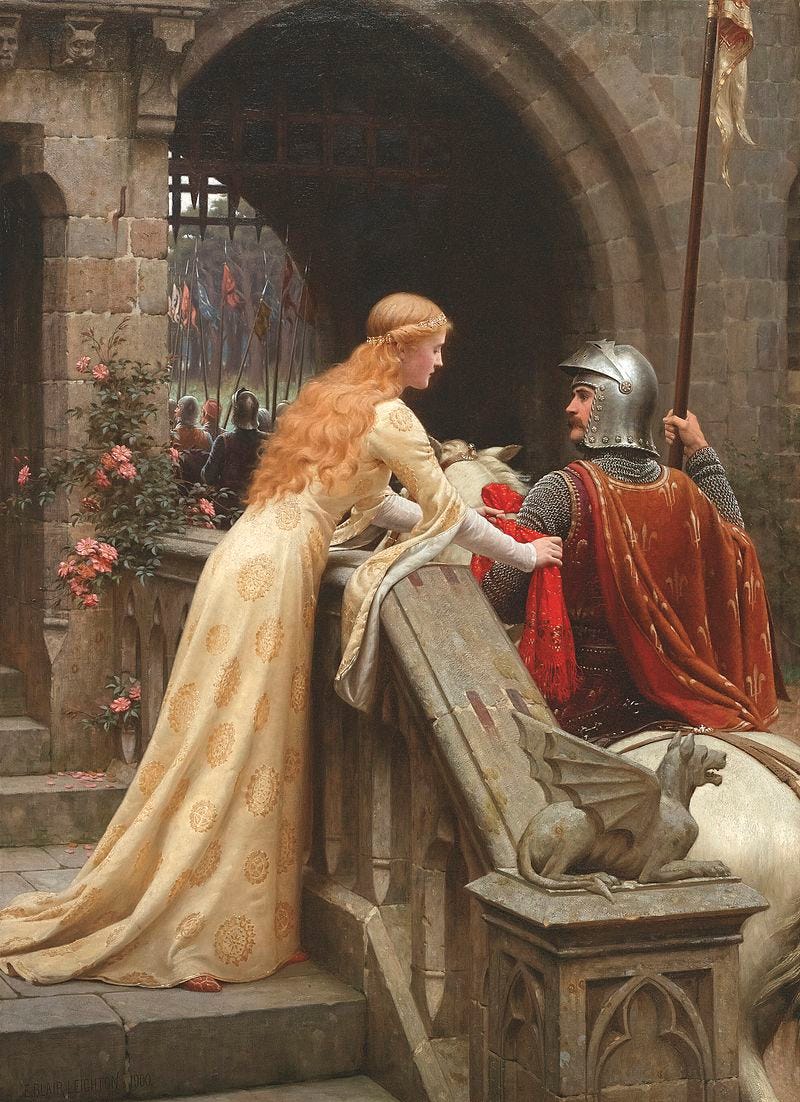
The masculine is most often associated with roughness and ambition today, often in a negative light. Even many modern figures pushing a positive view assert the conquering nature of men throughout history as the centerpiece of masculinity. They see the masculine figure as a man who owes no loyalty to a wife or children, no call for humility or peace-seeking, and no value for gentleness or mercy. They do not understand that only the strong can show mercy and only the dangerous can be gentle.
The knight is a conqueror, but he is first a servant of his lord and of his realm. He is gentle and merciful, and he does not turn to violence except when necessary. He understands that his strength comes from such restraint.
Peddlers of weak forms of modern masculinity revel in power and prestige and create slaves to baser instincts that only mask their own deficiencies in virtue. They, alongside their anti-masculine counterparts, only see the masculine through the lens of power. They consider a man’s base form to be that of a king or a warlord.
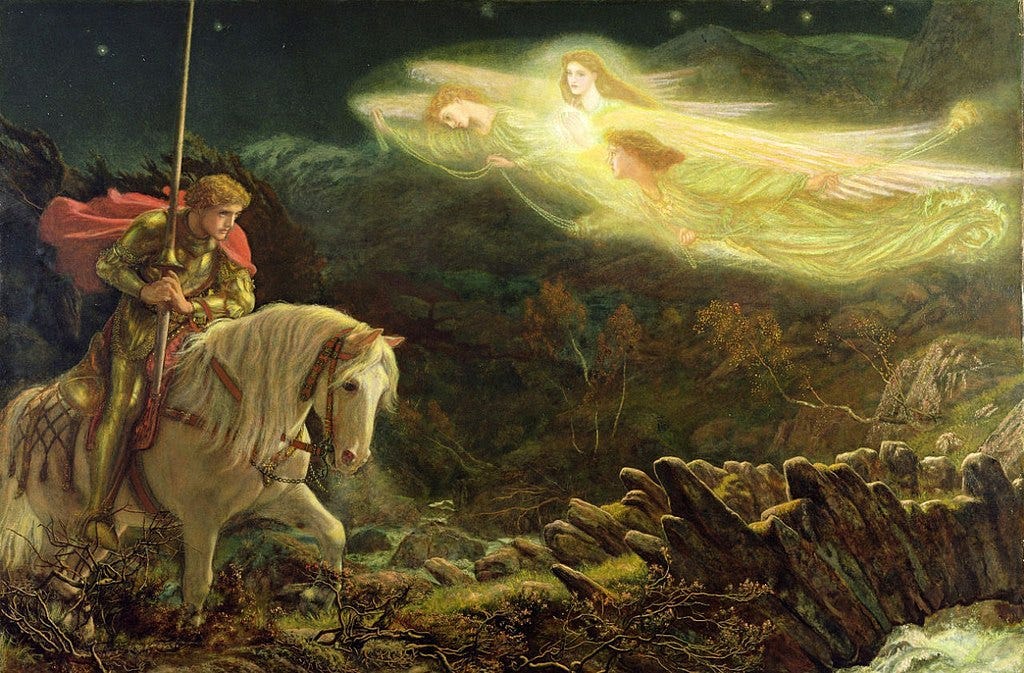
The default masculine archetype is not the king, however, it’s the knight. The Hero of the Monomyth is a knight first and foremost even if he is also a king. This is the form and duty set before man. It is a call to cultivate virtue, to exercise body and mind, to act with gentleness and mercy, and to brave dangers when others cannot. As I wrote in “The Princess and the Knight,” the masculine is revealed alongside the feminine. One cannot be understood without the other and if one is held in higher esteem than the other, it is done out of ignorance of both.
If the oath is at the heart of chivalric masculinity, then what virtue comes first? Honor. This honor is manifested in one’s loyalty to his lord and people, his willingness to put others before himself, and the care he shows to the vulnerable around him. There is a hierarchy to virtue and to its exercise, as with all things. A knight’s loyalty is owed first to God, then the one to whom an oath is made.
It is not ambition, pride, or power that set the foundation for the masculine, but the promise, the pledge, the covenant.