

Between my second and third years of undergrad, I finally read the Harry Potter books, years after the series had actually ended. I enjoyed them well-enough, but they didn’t grip me the same way they did for so many others. I saw charm and merit in them, good characters, and strong themes, but the world-building was weak and the culture surrounding the series was often tiresome (sorry). Early last year, I read a post on Quora where a person described the series as Harry maturing to the point of accepting death. That piqued my interest.
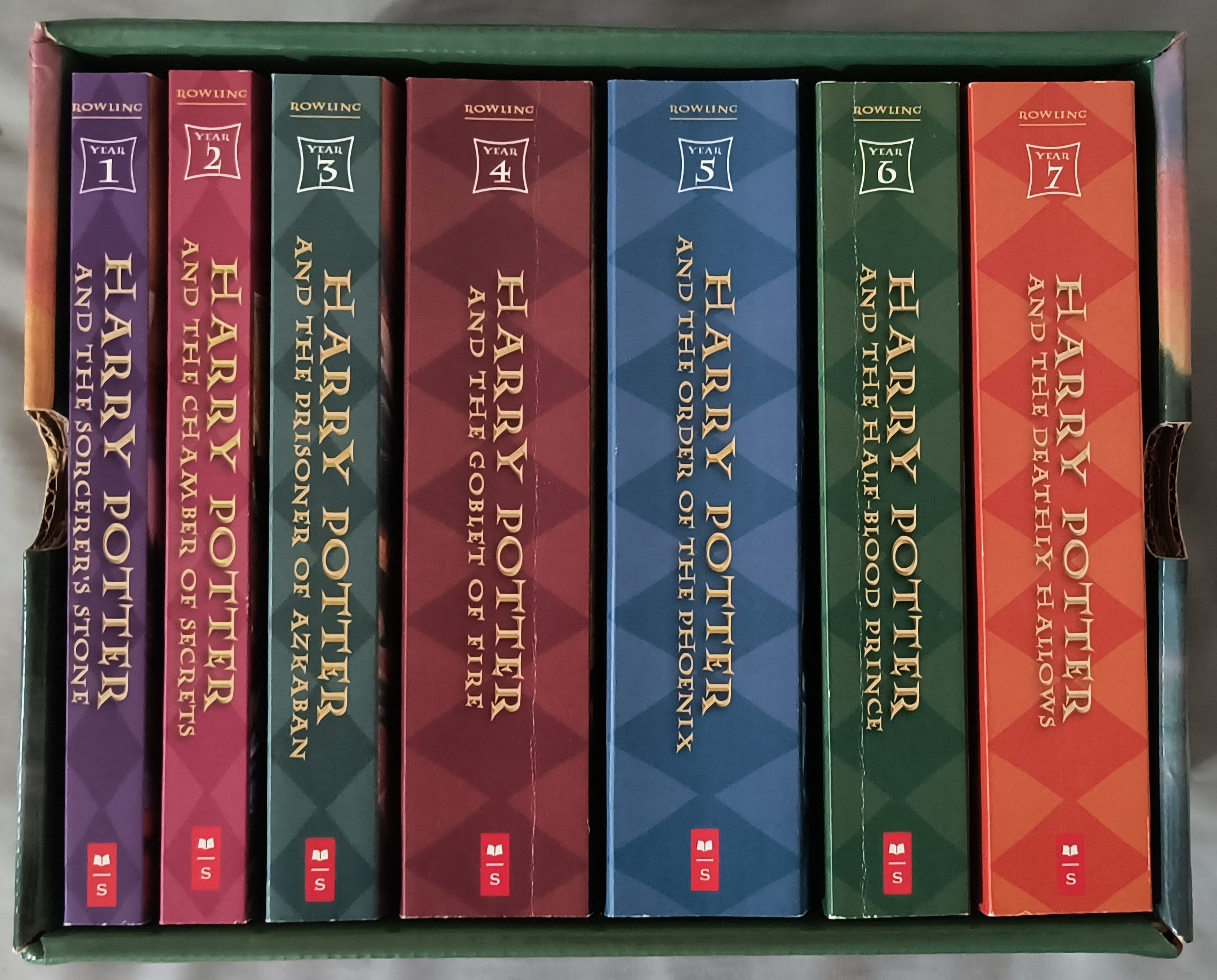
I thought through what I remembered of the books, not the movies, and decided I wanted to give them another try. Over the course of a few weeks, I reread all seven books and came away with a much deeper appreciation of the series. Looking at the story through the lens of death as its central theme made it, ironically, come alive. This post will deal with the first four books, next week’s will look at books five and six, then the seventh book will have a post all to itself the following week.
While the theme of death is not used subtly in the series, there were certainly elements of it that I appreciated far more when reading with that theme in mind. It truly is more than one theme among many, it is the primary theme of the entire Harry Potter series.
We get our first direct look at this theme in Harry’s conversation with Firenze near the end of The Philosopher’s Stone while the former is serving detention in the Forbidden Forest.
“That is because it is a monstrous thing to slay a unicorn,” said Firenze. “Only one who has nothing to lose, and everything to gain, would commit such a crime. The blood of a unicorn will keep you alive, even if you are an inch from death, but at a terrible price. You have slain something so pure and defenseless to save yourself, and you will have but a half-life, a cursed life, from the moment the blood touches your lips.”
[…]
“But who’d be that desperate?” [Harry] wondered aloud. “If you’re going to be cursed forever, death’s better, isn’t it?”
“It is,” Firenze agreed, “unless all you need is to stay alive long enough to drink something else—something that will bring you back to full strength and power—something that will mean you can never die. […]” (The Philosopher’s Stone, 258)
It is here that we are introduced to an idea that will be brought back multiple times throughout the series. There are fates worse than death, and one would need to fear death above all else in order to take them on. Voldemort is willing to risk such a curse in order to return to full life and power because he cannot recognize anything worse than dying.
Death is so great a menace in his mind that his quality of life is ultimately expendable so long as it is extended. Of course, he is risking this due to the promise of the Philosopher’s Stone, but there was always the chance that he would never obtain it. His decision to drink the blood shows his contempt for life as much as it does his fear of death.
In contrast, there are many characters across the series who display a willingness to die or to risk the quality of their own lives, but it is done not out of contempt for life or personal fear, but courage and/or an acceptance of death. They recognize that there are things worth dying for, and that a life well-lived must come to a natural end. The willingness to die, or the readiness to die, is brought up when Harry speaks with Dumbledore in the hospital wing at the end of the first book about the fate of the Flamels.
“They have enough Elixir stored to set their affairs in order and then, yes, they will die.”
Dumbledore smiled at the look of amazement on Harry’s face.
“To one as young as you, I’m sure it seems incredible, but to Nicholas and Perenelle, it really is like going to bed after a very, very long day. After all, to the well-organized mind, death is but the next great adventure. You know, the Stone was really not such a wonderful thing. As much money and life as you could want! The two things most human beings would choose above all—the trouble is, humans do have a knack of choosing precisely those things that are worst for them.” (PS, 297)
This conversation parallels the final conversation between Harry and Dumbledore in the King’s Cross chapter of The Deathly Hallows. In both conversations, Dumbledore notes that particular items with extraordinary abilities are not truly as amazing as they might seem. The Philosopher’s Stone may grant longevity and wealth, but it cannot bring you anything meaningful to fill your life with. That remains up to you.
For Voldemort, life is not even the priority, it is a means to the end of avoiding death. The Philosopher’s Stone is just as seductive a power as the Elder Wand or the Resurrection Stone. It is power without restraint, and it will corrupt and destroy whoever seeks it for the wrong reasons. Life simply for the sake of not dying is not a worthy pursuit, neither is power for the sake of power.
There were no particular passages I found to quote from The Chamber of Secrets, but the theme of death is still present. One obvious example is in the increased prominence of the Hogwarts ghosts. Sir Nicholas’s Death Day Party provides a glimpse at the sad state the ghosts exist in, something which Nicholas expands on at the end of book five. Moaning Myrtle especially seems to be one who could not fully accept her death and now exists in painful stasis, haunting the stalls of the bathroom where she died. They exist in a state of shadow. They stayed back to witness life move on without them, but they are unable to participate.
The ghosts are little more than memories imprinted on the school grounds. They are helpless and neither living nor truly dead. More can be said about the ghosts, but that will be saved for next week’s discussion of Order of the Phoenix.
Tom Riddle’s diary, as the second on-screen attempt for Voldemort to conquer death, attempts to weaponize its imprinted memory to steal life from Ginny. One must be robbed of life so that another might live. This is true with regard to the existence of Voldemort’s horcruxes and it is true in each of his attempts to return to full life. A life taken and a life received.
Within The Prisoner of Azkaban, we see the shadow of death in Harry’s confrontations with the dementors. He hears the final cries of his mother each time they approach him, forcing him to experience his parents’ deaths more directly than ever before.
An intense cold swept over them all. Harry felt his own breath catch in his chest. The cold went deeper than his skin. It was inside his chest, it was inside his very heart…
Harry’s eyes rolled up into his head. He couldn’t see. He was drowning in cold. There was rushing in his ears as though of water. He was being dragged downward, the roaring growing louder…
And then, from far away, he heard screaming, terrible, terrified, pleading screams. He wanted to help whoever it was, he tried to move his arms, but couldn’t … a thick white fog was swirling around him, inside him— (The Prisoner of Azkaban, 83-84)
The dementors caused Harry to deal with the reality of death and his fears. Death up until this point had been an opaque nightmare of flashing green lights and grief over his parents, but the dementors force him to experience his mother’s death more clearly.
The loss of his parents grows heavier in his mind, and we see him consider his fears in light of this renewed grief. It’s made clear that Harry is not chiefly afraid of Voldemort or his own death, rather he is afraid of falling into the clutches of such fear. He discusses this with Lupin, reflecting on their lesson with the boggart, a creature which transforms into what a person fears most.
“Well,” said Lupin, frowning slightly, “I assumed that if the boggart faced you, it would assume the shape of Lord Voldemort.”
[…]
“Clearly, I was wrong,” said Lupin, still frowning at Harry. “But I didn’t think it a good idea for Lord Voldemort to materialize in the staffroom. I imagined that people would panic.”
“But then,” said Harry honestly. “I—I remembered those dementors.”
“I see,” said Lupin thoughtfully. “Well, well… I’m impressed.” He smiled slightly at the look of surprise on Harry’s face. “That suggests that what you fear most of all is—fear. Very wise, Harry.” (PoA, 155)
Fear is innate within human life. We simply can’t avoid it. We all have fears as varied as those seen within the boggart lesson. Some of us fear tangible threats such as murderers, sickness, beasts, or injury. Others fear the intangible such as madness, death, pain, and sorrow. Harry’s fear stems from his lived experience of genuine horrors. His fear is not of the horrors themselves but of finding himself unable to push back against them. His fear is not directly of death but rather the fear that death might be worth fearing, that the loss of his parents is even greater than it already seems.
Once we arrive at The Goblet of Fire, the series takes a darker turn. Harry has confronted and survived encounters with servants of Voldemort and even a fragment of Voldemort’s soul. However, while death has always cast a shadow over his life, Harry has never dealt with it head on up to this point. Death is a vague memory of screams and green flashes, not a real and present pain. It’s something of the past, a painful jolt of nostalgia for what could have been. His first real encounter with death, face to face, comes during Fake Moody’s lesson on the Unforgivable Curses. The final spider is doomed as the only curse remaining is death.
So that was how his parents had died…exactly like that spider. Had they been unblemished and unmarked too? Had they simply seen the flash of green light and heard the rush of speeding death, before life was wiped from their bodies? (The Goblet of Fire, 216)
This is, of course, not the first time Harry has seen a spider or insect die. It is, however, the first time such a death is put into the context of how his parents had died. This spider shared their fate. He now knows what their final moments may have been like, and that their lives were snuffed out without a trace. Life is fragile, and the illusion of the untouched corpse masks the horror of what just occurred.
Perhaps we can sympathize with Voldemort’s fear of death and quest for immortality. As I said above, it is natural to fear death and to avoid it. He uses this quest to conquer death as a boast for his powers, but this, too, is an illusion. It disguises his terror that he might one day cease to exist. Despite all his powers, despite his knowledge and skill, he cannot simply defeat death with brute force. His powers are meaningless. No thoughts of an afterlife could comfort Voldemort because death in his mind is final. Nothing can surpass it or exist beyond it. Death is the enemy, and it is one that must be avoided, if never truly defeated.
“And then I ask myself, but how could they have believed I would not rise again? They, who knew the steps I took, long ago, to guard myself against mortal death. They, who had seen proofs of the immensity of my power in the times when I was mightier than any wizard living?” (GoF, 648)
This monologue from Voldemort mirrors the conversation between Harry and Firenze in The Philosopher’s Stone. Ultimately, his pursuit is a desperate clinging to life. He survives only in the most generous of definitions, having mutilated his soul and cursing himself. Life is not meaningful to Voldemort, only the continuation of his power. He goes on to discuss the pain and suffering he experienced as a result of his attempted murder of Harry, showcasing how far he has fallen and how desperate and terrified he truly is of death.
“I miscalculated, my friends, I admit it. My curse was deflected by the woman’s foolish sacrifice, and it rebounded upon myself. Aaah… pain beyond pain, my friends; nothing could have prepared me for it. I was ripped from my body, I was less than spirit, less than the meanest ghost… but still, I was alive. What I was, even I do not know… I, who have gone further than anybody along the path that leads to immortality. You know my goal—to conquer death. And now, I was tested, and it appeared that one or more of my experiments had worked… for I had not been killed, though the curse should have done it.” (GoF, 653)
The conquest of death. He survived. He suffered terribly, but he survived. Surely a life of such debasement and inhumanity is not worth living, but life is not the goal. Voldemort’s search for immortality has nothing to do with life, it has to do with death. Death is to be feared. Life is a means to the end of avoiding death. It is expendable whether in regard to the lives of others or Voldemort’s own quality of life. So long as death is avoided, all else is secondary. Just like with the unicorn’s blood, Voldemort will curse his life if it means he escapes the cold embrace of the abyss.
Harry’s parents died by sacrificing themselves, considering their own survival as less important than another’s. This marks the key difference between Voldemort and those who resist him. Voldemort will sacrifice others for the sake of continued existence, but they will sacrifice themselves for the sake of others. And the irony is that while he strives to defeat death, it must always act as a looming shadow over his half-life.
Next week we will continue with books 5 and 6.
I used to fear death or at least the end of life as I knew it. Or death of my idea of a good life. As I have grown older and stood vigil over several death beds, my outlook has morphed considerably. I no longer fear death nor losing this life. I simply rejoice in goodness, whether now or then.
I look forward to your writing about the deathly hallows. I envision a parallel of trinities when I think of that book.