

At this point, if J.K. Rowling hadn’t already made clear the importance of death in the series, she removes all potential ambiguity by placing two quotes about death just before the first chapter of The Deathly Hallows.
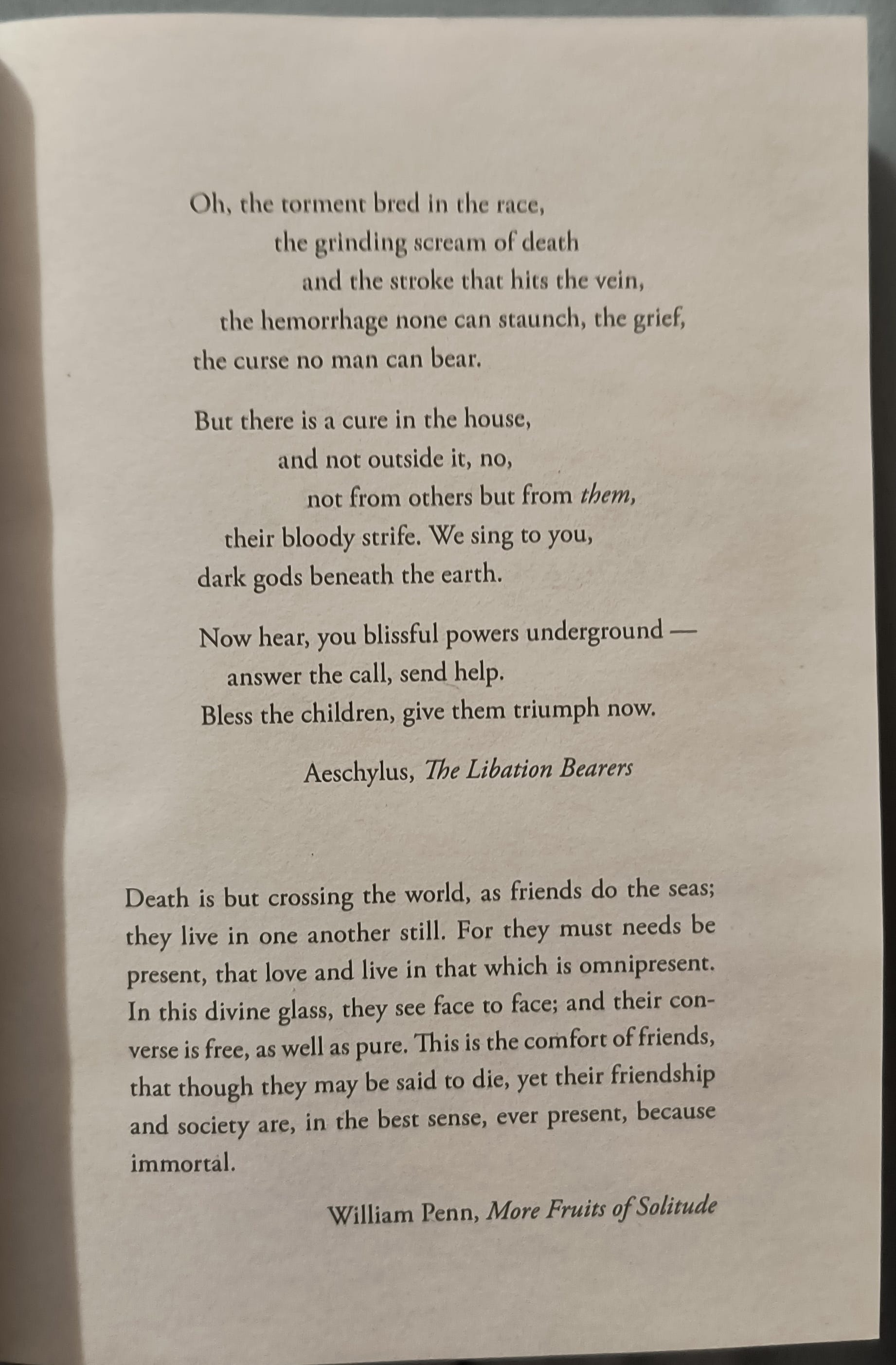
Perhaps the most direct exploration of death within the seventh book comes in the Tale of the Three Brothers. I will not share the full story here but simply recount the basics.
Three brothers on a walk at twilight thwart Death by conjuring a bridge over a dangerous ravine. In a calculated move, Death offers each brother a gift in return for their cleverness. In the decisions of the brothers, we see three perspectives on death.
The first brother asks for a wand more powerful than any other, so powerful he might never know defeat. The second brother wished to restore life to his loved ones, receiving the resurrection stone. And the third merely wanted the means to live without fear of death.
For the first brother, he wished for the power of death. He wanted to mete out death to all who might challenge him, leading to hubris and an undignified death of his own. The second brother wished to defeat and humiliate death by denying him the spirits of the dead. When it turned out that such spirits could only live a feeble imitation of life, as they no longer belonged to this material plane, he took his own life in sorrow.
The third brother had no desire for power or to overcome death by force. He wished to live and not see the looming shadow of death in his life, thus he received the invisibility cloak. When his death finally came, he accepted it as the fate of all humanity and passed on his wisdom to his son. The invisibility cloak represents, in this story, the life lived without fear of or obsession with death.
Death is defeated not by gaining power or denying the natural end of life for oneself or others, rather it is defeated by accepting its inevitability and choosing to live outside its shadow. Those who seek to prevail over death or command it themselves end up being ruled by it. When Harry and Hermione visit the graves of Lily and James Potter, they find an inscription on the gravestone from 1 Corinthians 15:26, “The last enemy that shall be destroyed is death.”
“‘The last enemy that shall be destroyed is death’…” A horrible thought came to him, and with it a kind of panic. “Isn’t that a Death Eater idea? Why is that there?”
“It doesn’t mean defeating death in the way the Death Eaters mean it, Harry,” said Hermione, her voice gentle. “It means…you know…living beyond death. Living after death.”
But they were not living, thought Harry: they were gone. The empty words could not disguise the fact that his parents’ moldering remains lay beneath snow and stone, indifferent, unknowing. And tears came before he could stop them, boiling hot then instantly freezing on his face, and what was the point in wiping them off or pretending? He let them fall, his lips pressed hard together, looking down at the thick snow hiding from his eyes the place where the last of Lily and James lay, bones now, surely, or dust, not knowing or caring that their living son stood so near, his heart still beating, alive because of their sacrifice and close to wishing, at this moment, that he was sleeping under the snow with them. (The Deathly Hallows, 328)
Comforting ideas of the afterlife oftentimes ring hollow in the wake and presence of tragedy. How can death be defeated when it’s just won? A loved one has died, death is victorious. Where is the hope? We all must die, and recognizing this fact does not take away the sting of death so easily. There is still the dread of the long dark, the fear of the unknown.
Seeing the inevitability of death on its own does not defeat death. Knowing your impending doom may simplify things, but it does not vanquish death from our imaginations and fears. There are no easy answers. Part of overcoming the fear of death lies in recognizing that it is a fearful thing indeed, not in the sense that Death himself is worthy of fear but that we must leap into the unknown with hope of more.
Harry eventually comes to understand his role in the battle against Voldemort after seeing Snape’s memories. He understands that the final horcrux lives inside of him and that it must be purged if Voldemort is to be defeated. What follows is a powerful reflection on death as he makes his way toward the end.
Finally, the truth. Lying with his face pressed into the dusty carpet of the office where he had once thought he was learning the secrets of victory, Harry understood at last that he was not supposed to survive. His job was to walk calmly into Death’s welcoming arms. Along the way, he was to dispose of Voldemort’s remaining links to life, so that when at last he flung himself across Voldemort’s path, and did not raise a wand to defend himself, the end would be clean, and the job that ought to have been done in Godric’s Hollow would be finished: Neither would live, neither could survive.
[…]
Terror washed over him as he lay on the floor, with that funeral drum pounding inside him. Would it hurt to die? All those times he had thought that it was about to happen and escaped, he had never really thought of the thing itself: His will to live had always been so much stronger than his fear of death. Yet it did not occur to him now to try to escape, to outrun Voldemort. It was over, he knew it, and all that was left was the thing itself: dying.
If he could only have died on that summer’s night when he had left number four, Privet Drive, for the last time, when the noble phoenix-feather wand had saved him! If he could only have died like Hedwig, so quickly he would not have known it had happened! Or if he could have launched himself in front of a wand to save someone he loved… He envied even his parents’ deaths now. This cold-blooded walk to his own destruction would require a different kind of bravery. (DH, 691-92)
The kinds of deaths that Harry envies are those of randomness and purpose. Hedwig’s death was mere chance, the curse hitting the snowy owl and not Harry himself. Death without a moment’s realization. A quick cut to black. Painless. No fear involved. No drum roll.
Harry’s parents made tangible sacrifices for their child, casting themselves before Voldemort as he stalked his way through the house. Their deaths had clear and discernible meanings. Their sacrifices were concrete. Their deaths had purpose.
Sure, Harry’s death might enable the eventual defeat of Voldemort, but it is an abstract and ephemeral purpose to a very real and concrete death. There are no comforts in contingencies when your lifespan has been cut to mere minutes. Harry is forced to accept death not as a distant inevitability but as a conscious decision on his part, sacrificing himself for others.
There is a clear, though limited, Christian allegory here in that Harry moves toward death, not losing his life but giving it. His decision is a clear reflection of the words of Jesus in John 10:17-18, “For this reason the Father loves me, because I lay down my life that I may take it up again. No one takes it from me, but I lay it down of my own accord.” Harry must deliberately bring about his own death in order to vanquish evil.
On his long walk to the place of execution, Harry realizes that he has possessed the resurrection stone all along within the golden snitch. He utilizes it not to defeat death by robbing the afterlife of souls, but instead he uses it to steel himself for his own death, to find comfort in the reality that existence endures. He is able to see and speak with his loved ones who had died before him, each one having given their own lives in the struggle.
A chilly breeze that seemed to emanate from the heart of the forest lifted the hair at Harry’s brow. He knew that they would not tell him to go, that it would have to be his decision.
“You’ll stay with me?”
“Until the very end,” said James.
“They won’t be able to see you?” asked Harry.
“We are part of you,” said Sirius. “Invisible to anyone else.”
Harry looked at his mother.
“Stay close to me,” he said quietly. (DH, 700)
A life given and life protected. He dies. A cut to black. The purpose of his death still abstract, the effects unknown, but he faces it nonetheless. Upon waking up in King’s Cross, Harry’s conversation with Dumbledore helps to further illuminate the role of the Hallows as well as finally establishing for Harry that death no longer has its sting.
The Hallows are no prize. They do not make one master of death because none can truly conquer death in this way. Two of the three brothers in the tale attempted to master death with their own Hallows and both failed. Even the three Hallows together cannot grant one such power.
“Maybe a man in a million could unite the Hallows, Harry. I was fit only to possess the meanest of them, the least extraordinary. I was fit to own the Elder Wand, and not to boast of it, and not to kill with it. I was permitted to tame and to use it, because I took it, not for gain, but to save others from it.
“But the Cloak, I took out of vain curiosity, and so it could never have worked for me as it works for you, its true owner. The stone I would have used in an attempt to drag back those who are at peace, rather than to enable my self-sacrifice, as you did. You are the worthy possessor of the Hallows.” (DH, 720)
Self-sacrifice is the key to understanding the role death plays in this series. While many of the deaths are those of soldiers in battle, there is still the overarching idea that they died fighting for others. Even a random death like that of Cedric Diggory finds purpose in the path taken by Harry in defeating Voldemort. It is not death that has meaning, but life. Harry’s death was not meaningful, the giving of his life was. The conquest of death is the embracing of life and the understanding that we endure beyond the grave.
Harry is worthy of the Hallows not because they grant him power over death, but because he accepts that they do not. He is still subject to death in this world, but now there is nothing to fear.
“I think,” said Dumbledore, “that if you choose to return, there is a chance that he may be finished for good. I cannot promise it. But I know this, Harry, that you have less to fear from returning here than he does.”
Harry glanced again at the raw-looking thing that trembled and choked in the shadow beneath the distant chair.
“Do not pity the dead, Harry. Pity the living, and, above all, those who live without love. By returning, you may ensure that fewer souls are maimed, fewer families are torn apart. If that seems to you a worthy goal, then we say good-bye for the present.” (DH, 722)
Although no clear thoughts regarding the afterlife are given within the series, it is made clear that life goes on, both on earth and beyond. There are spirits that continue, and they are aware. There is love beyond the grave and hope in the loss of life. Death to Harry becomes merely a reunion with those he loves. It is not a childish fantasy, but a reality. It takes little courage to state that existence ends with death and all that exists is material. Harry’s parents are not mere bones resting beneath the snow. They live on, both in him as he carries their memories forward, and in the life to come.
Perhaps such a fate makes Voldemort’s fear of death all the worse. The fact that death is not simply a cut to black, but that existence endures, is far more horrifying for one so desperate to cling on to an imitation of life. Despite all his efforts, Voldemort dies an ordinary and unremarkable death. A meaningless end to a meaningless life spent in pursuit of mere survival.
And Harry, with the unerring skill of the Seeker, caught the wand in his free hand as Voldemort fell backward, arms splayed, the slit pupils of the scarlet eyes rolling upward. Tom Riddle hit the floor with a mundane finality, his body feeble and shrunken, the white hands empty, the snakelike face vacant and unknowing. (DH, 744)
A death like any other man. Voldemort falls back without realizing what has happened. As to his fate in the next life, we can only guess. Perhaps his soul was so obliterated that what remained simply could not carry on and he truly did cease to exist. I don’t think so, though. I believe he endured, but only just. A life beyond life, one filled with love and hope would be agony to one such as Voldemort. He will find no rest among the dead, only more pain and fear.
When Harry tells him to try for some regret and remorse, to understand his actions properly, Voldemort is disgusted with the idea. It is this unwillingness to repent that makes Voldemort’s life and death meaningless. If he had repented and died right there, perhaps purpose might be found, but instead he died in pursuit of that which could never be his on his own terms: life without death.
In the end, there is hope. Death will come for us all the same, but where is death’s sting when we know that existence endures, that our loved ones remain with us and that we hope to reunite with them? Our lives are made more meaningful by the fact that they go on and that our decisions here have a true moral impact on the world around us and our eternal destinies.
Death does not truly separate those with hope. Love is what binds us to those no longer with us. It is what remains of us when we’re gone, lost to the world, our bodies turning to dust. It’s what leaves us in the memories of others. We are known either by how we loved or how we did not.
If love is a worthy pursuit, and it truly has meaning, then love continues beyond death. Love can never be one-sided, and as love endures, so do we all.